Concrete floors · Tyler, TX
Concrete floor installation in Tyler for garages, shops and barns
We install concrete floors in Tyler, TX for garages, metal shops, barns, storage buildings and workshops. The floor is graded, reinforced and finished level, with a smooth trowel finish where you roll tools and a broom finish where you need grip.

Signs it's time
Your building needs a real floor
- A new metal building or barn is going up
- A dirt or gravel floor is dusty, muddy or uneven
- An old garage floor is cracked, stained or holding water
- You need a floor that can take a vehicle, equipment or a lift
Built around what goes on it
A floor for a riding mower and a floor for a loaded truck are different slabs. Thickness, steel and sometimes thickened sections under heavy equipment are set by what the floor will carry. Tell us about vehicles, lifts, racking or heavy machines before we pour.
Flat, level and drained
Inside a garage or shop, the floor usually slopes slightly toward the door so water from a washed truck runs out. Elsewhere it is poured level. A vapor barrier under the slab helps keep ground moisture from coming up through the floor, which matters if you plan a coating later.
Finish choices
- Steel trowel: smooth and dense, easy to sweep, good for shops and rolling tool carts.
- Broom finish: more grip, better near doors where it gets wet.
- Ready for a coating: if you want epoxy later, the floor still needs to cure first, then it gets ground before coating.
Joints in a shop floor
Big floors need control joints to keep cracking under control. They are saw-cut within a day of the pour on a grid sized to the slab thickness. We lay them out so they do not land where they will bother you, like the middle of a lift bay. What control joints do.
Done to standard
How we do it to standard
-
No blisters a month later.
We test slab moisture before coating, and do not coat a slab that fails.
Moisture coming up through the slab pushes coatings off as blisters.
Standard ASTM F2170 (in-slab relative humidity probes) and ASTM F1869 (calcium chloride test) are the standard concrete moisture tests.
-
Thick enough for what you actually own.
We ask what will drive, park or sit on the slab before setting the thickness, and thicken it where trucks, trailers, an RV or a lift will go.
Thickness is the one thing that cannot be added after the pour. A slab sized for a sedan cracks under a loaded trailer.
-
Cracks go where we put them.
We lay out control joints by slab thickness and shape, and keep panels close to square.
Concrete shrinks as it cures and will crack somewhere. Joints decide where, so the crack lands in a straight line instead of across the middle of a panel.
Standard ACI 302.1R and the Portland Cement Association put joint spacing at about 24 to 36 times the slab thickness (8 to 12 feet for a 4-inch slab).
-
Summer concrete that cures instead of drying out.
We pour early in the day in summer, keep materials and the base cool and damp, and protect the surface from drying wind and sun.
In a Tyler summer, the surface can lose water faster than the concrete can set, which leaves shrinkage cracks and a weak, dusty top.
Standard ACI 305R (Guide to Hot Weather Concreting) recommends precautions when the evaporation rate approaches 0.2 lb per square foot per hour.
-
Real reinforcing steel, tied properly.
We use deformed reinforcing bar to the ASTM A615 standard, tied at the laps and intersections.
Rebar grade and laps decide whether the steel can carry load across a crack.
Standard ASTM A615 covers deformed carbon-steel bars for concrete reinforcement; Grade 60 is the common residential grade.
-
Code minimum is where we start.
We pour interior slabs on ground no thinner than the code minimum, and thicker where the use calls for it.
The code sets the floor, not the target. Shops and garages usually need more.
Standard IRC R506.1: concrete slab-on-ground floors must be at least 3-1/2 inches thick.
Step by step
How a floor job goes
-
Plan the loads
Vehicles, lifts, equipment, drainage.
-
Grade and base
Level, compact, vapor barrier.
-
Steel and pour
Rebar grid, then the pour.
-
Finish and cut
Trowel or broom, saw-cut joints, cure.
Know the words
Terms you'll hear
- Slab moisture
- Water vapor moving up through a concrete slab. It pushes coatings off as blisters. It is tested, not guessed.
- Slab-on-grade foundation
- A single concrete slab poured on the ground with thickened beams, instead of a crawlspace or basement. It is the standard foundation in East Texas, and on clay its design matters more than anything else.
- Drying shrinkage cracks
- Cracks from concrete shrinking as it cures and dries. Normal and expected. Joints are there to catch them.
- Thickened edge
- A deeper section along a slab edge or under a load. Edges carry tires, posts and walls, and they are where thin slabs break first.
- Anchor bolts
- Bolts set in the wet slab to tie walls or a metal building down. They have to land exactly where the building kit needs them. There is no moving them later.
- Vapor retarder
- Polyethylene sheeting laid under a slab to slow ground moisture coming up through it. Moisture through the slab ruins flooring and blisters coatings.
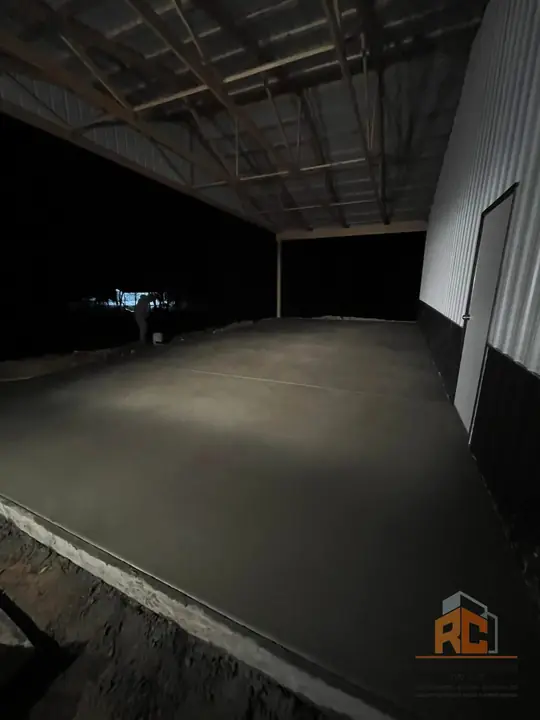
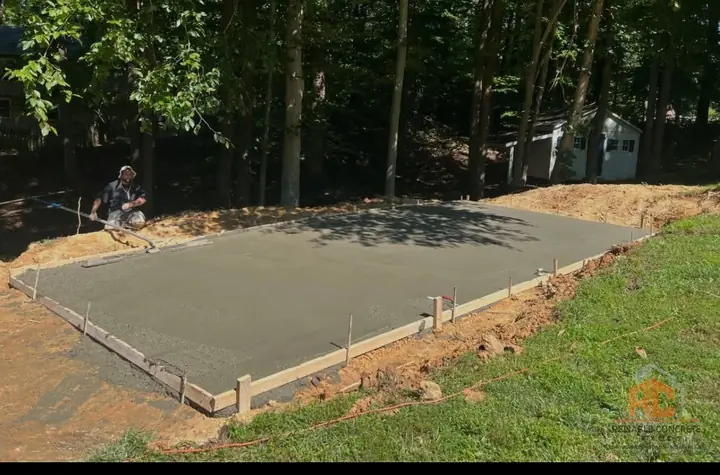
From our recent work
More photos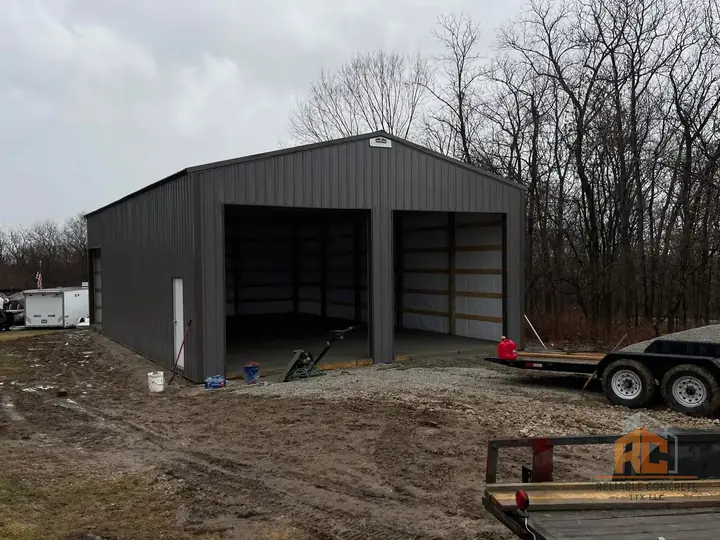
Questions we hear
Frequently asked
How thick should a garage floor be?
Many garage floors are about 4 inches, and shop floors for heavy trucks or a car lift are usually thicker, sometimes with thickened pads under the lift.
Can you pour a floor inside an existing building?
Yes, as long as the truck or a pump can reach the doorway. We plan the pour around the building.
When can I coat a new floor with epoxy?
Most coatings need the concrete to cure about a month and pass a moisture check first.
Ready to talk about your concrete?
Let's get your project on solid ground.
Tell us what you need and we'll get back to you to talk it through and set up a time to look at the job.
Prefer to call?(903) 555-0100