
Concrete driveways · Tyler, TX
Concrete driveway installation in Tyler for cars, trucks and trailers
We install concrete driveways in Tyler, TX: brand-new drives, full replacements, gravel-to-concrete conversions, garage aprons and extensions. Every one is graded, based, reinforced and jointed for the ground it sits on.

Signs it's time
Your driveway is holding you back
- Gravel ruts, washes out after storms or tracks into the house
- Most panels are cracked, heaved or sunk, not just one
- You need another parking spot, a turnaround or room for a trailer
- Water sits on the drive or runs toward the garage
What goes under a driveway that lasts
Driveways rarely fail from the top. They fail because the ground under them moved or washed out. So before any concrete shows up, the area is excavated, soft spots are dug out, and a compacted base goes down to give the slab even support.
- Thickness: about 4 inches is common for cars, with 5 to 6 inches where trucks, trailers or an RV will park. How thick should a driveway be?
- Reinforcement: rebar or wire mesh set on chairs so it ends up inside the slab, not lying in the dirt.
- Slope: enough fall that rain runs off toward the street, not into the garage.
- Control joints: cut at a spacing tied to the slab thickness so cracks follow the lines. What control joints do.
- Finish: a broom finish for grip on a wet, sloped drive.
New, replacement or gravel to concrete
A new driveway on a fresh lot is the simplest case. A replacement adds tear-out and haul-off of the old slab, which we handle as part of the job. Converting a gravel drive usually means pulling up the loose rock, reshaping the grade and building a proper base, since driveway gravel is rarely compacted enough to pour on.
Not sure if yours can be saved? Cracks in one or two panels can often be repaired instead. Repair or replace?
Aprons, extensions and parking pads
The apron, where the drive meets the street or the garage, takes the hardest hits and is often the first section to break. Extensions widen a single drive to a double, and parking pads add a spot for a boat, trailer or third car. Tying new concrete into old properly, with dowels or an isolation joint, stops the two from cracking at the seam.
Aprons at the street can touch the City of Tyler right-of-way. What to check before work at the curb.
Built for East Texas summers
Concrete costs more up front than asphalt but needs less upkeep, stays cooler in an East Texas summer and does not soften in the heat. Asphalt needs resealing every few years. Compare them side by side.
Done to standard
How we do it to standard
-
Thick enough for what you actually own.
We ask what will drive, park or sit on the slab before setting the thickness, and thicken it where trucks, trailers, an RV or a lift will go.
Thickness is the one thing that cannot be added after the pour. A slab sized for a sedan cracks under a loaded trailer.
-
The concrete you keep is untouched.
We saw-cut a straight line wherever removed concrete meets concrete that stays.
Breaking without a cut chips and cracks the slab you meant to keep.
-
Cracks go where we put them.
We lay out control joints by slab thickness and shape, and keep panels close to square.
Concrete shrinks as it cures and will crack somewhere. Joints decide where, so the crack lands in a straight line instead of across the middle of a panel.
Standard ACI 302.1R and the Portland Cement Association put joint spacing at about 24 to 36 times the slab thickness (8 to 12 feet for a 4-inch slab).
-
The seam between old and new stays level.
We drill and dowel new concrete into old where they must move together, or set an isolation joint where they must move apart.
An extension poured against old concrete with nothing between them cracks or steps at the seam within a season or two.
-
You spend on the option that lasts.
We tell you plainly when a slab is past repairing and when it is not.
Repeated repairs on a failed slab cost more than replacing it. Replacing a sound slab wastes money the other way.
-
Built for the ground it actually sits on.
We treat East Texas clay as a design condition: base, steel, joints and drainage are sized for ground that swells wet and shrinks dry.
Expansive clay moves with the seasons. Concrete that ignores that movement cracks along lines nobody chose.
Standard Texas engineers measure clay movement as potential vertical rise (PVR), using the TxDOT Tex-124-E method.
Step by step
How a driveway job goes
-
Measure and plan
Size, thickness, slope, and where vehicles turn and park.
-
Tear-out and grade
Old concrete or gravel out, ground shaped and compacted.
-
Forms and steel
Forms set to grade, rebar or mesh placed on chairs.
-
Pour and finish
Placed, screeded, broom finished, joints cut and cured.
Know the words
Terms you'll hear
- Heave
- A slab pushed up by swelling clay or roots. It creates trip edges and cracks that open and close with the seasons.
- Expansive clay
- Clay that swells when wet and shrinks when it dries. It is the main reason East Texas concrete cracks, heaves and settles.
- Section replacement
- Cutting out broken panels and repouring them tied to the slabs around them. Often cheaper than replacing a whole driveway when the damage is local.
- Thickened edge
- A deeper section along a slab edge or under a load. Edges carry tires, posts and walls, and they are where thin slabs break first.
- Dowel bars
- Short steel bars drilled and epoxied into an existing slab to tie new concrete to it. They keep new and old concrete level with each other at the seam.
- Sloped lot
- A yard with enough fall to need steps, walls or cut-and-fill. Grade changes are where walls, steps and drainage all meet.
From our recent work
More photos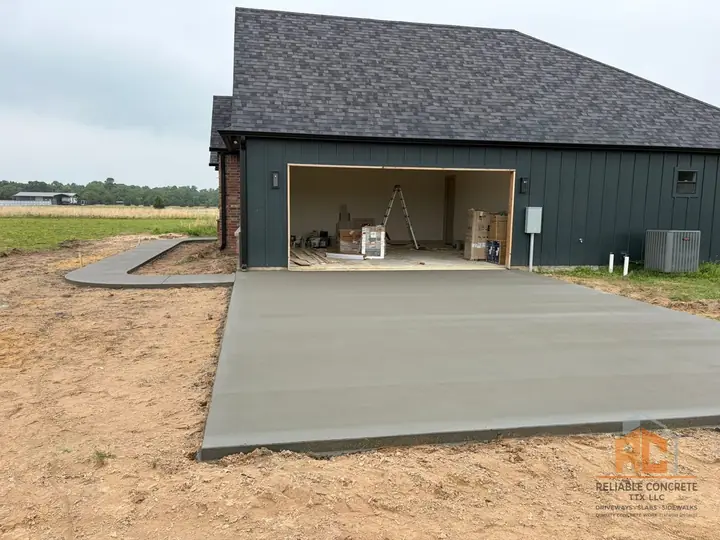

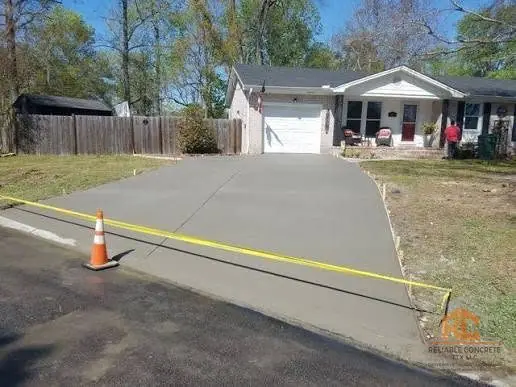
Questions we hear
Frequently asked
How long does a driveway take?
Most residential drives take a few days of prep and one day to pour, plus about a week of cure before cars. Tear-out and weather can add time.
How much does a concrete driveway cost in Tyler?
It depends on size, thickness, tear-out, base work, access for the truck and finish. We quote after seeing the site. What changes the price.
Will my new driveway crack?
Concrete shrinks as it cures, so some hairline cracking is normal. Good base, steel and joints keep cracks small and in the joints. Why concrete cracks.
How do I care for a new driveway?
Keep heavy vehicles off it through the cure, and consider a sealer once it has cured. Care guide.
Will new concrete match my old concrete?
New concrete is lighter at first and never matches exactly. It evens out with age.
Ready to talk about your concrete?
Let's get your project on solid ground.
Tell us what you need and we'll get back to you to talk it through and set up a time to look at the job.
Prefer to call?(903) 555-0100