
Concrete sidewalks · Tyler, TX
Concrete sidewalk installation in Tyler from the driveway to the back gate
We install concrete sidewalks in Tyler, TX: front walks from the drive to the door, side walkways along the house, paths out to a shed or shop, and sidewalks along the street. Each one is sloped to drain and jointed so cracks stay in the lines.

Signs it's time
Getting around the yard is a chore
- Guests cross mud or grass to reach the front door
- A worn path to the shed or the back gate turns to mud after rain
- An old walk has heaved, tilted or broken into trip hazards
- Pavers or stepping stones keep sinking and shifting
What makes a sidewalk last
A sidewalk is a long, narrow slab, and that shape makes it want to crack across its width. Control joints spaced roughly as far apart as the walk is wide give those cracks somewhere tidy to go. Most residential walks are 4 inches thick and 3 to 5 feet wide.
Walks along a house also need a slight cross slope so water runs away from the foundation. On clay, a compacted base under the walk keeps it from tilting toward or away from the house over time.
Front walks, side walks and paths
A front walk often ties into the driveway, and an L-shaped walk from the drive to the porch is one of the most common jobs we pour. Side walkways run along the house to the backyard, and paths connect the house to a shed, shop or pool. Steps can be formed in where the grade changes.
Sidewalks along the street
Sidewalks in the public right-of-way are a different job. In Tyler, work in the city right-of-way follows the City of Tyler's requirements, and commercial walks usually have to meet accessibility rules for width, slope and curb ramps. What to check with the city.
Repair or replace a walk?
A single sunken or lifted section is often a repair job: the panel can be leveled or ground down to remove a trip edge. When most of the walk is broken or tree roots have pushed it up, replacing it is the better spend. Why concrete sinks.
Done to standard
How we do it to standard
-
Built to pass the first time.
We build commercial and public walks to accessibility limits for width and slope.
A walk that is too steep or too narrow fails inspection and has to come out.
Standard 2010 ADA Standards 403: walking surfaces max 1:20 running slope and 1:48 cross slope, at least 36 inches clear width.
-
Cracks go where we put them.
We lay out control joints by slab thickness and shape, and keep panels close to square.
Concrete shrinks as it cures and will crack somewhere. Joints decide where, so the crack lands in a straight line instead of across the middle of a panel.
Standard ACI 302.1R and the Portland Cement Association put joint spacing at about 24 to 36 times the slab thickness (8 to 12 feet for a 4-inch slab).
-
The seam between old and new stays level.
We drill and dowel new concrete into old where they must move together, or set an isolation joint where they must move apart.
An extension poured against old concrete with nothing between them cracks or steps at the seam within a season or two.
-
Built for the ground it actually sits on.
We treat East Texas clay as a design condition: base, steel, joints and drainage are sized for ground that swells wet and shrinks dry.
Expansive clay moves with the seasons. Concrete that ignores that movement cracks along lines nobody chose.
Standard Texas engineers measure clay movement as potential vertical rise (PVR), using the TxDOT Tex-124-E method.
-
No surprise from the city.
We check city requirements before work in the street right-of-way, such as aprons and public sidewalks.
Work at the curb can need a permit and inspection. Finding out after the pour is expensive.
-
Each piece moves on its own.
We set isolation joint material where flatwork meets the house, columns, steps and existing slabs.
A slab locked to a foundation or a post cracks when either one moves.
Step by step
How a sidewalk job goes
-
Lay out the path
Route, width, steps and drainage.
-
Dig and base
Excavate, compact, add base.
-
Form and steel
Forms set to grade and cross slope.
-
Pour and joint
Placed, broom finished, joints tooled or cut.
Know the words
Terms you'll hear
- City right-of-way
- The public strip between private property and the street. Driveway aprons and public walks there follow city rules, not just the owner's.
- Heave
- A slab pushed up by swelling clay or roots. It creates trip edges and cracks that open and close with the seasons.
- Expansive clay
- Clay that swells when wet and shrinks when it dries. It is the main reason East Texas concrete cracks, heaves and settles.
- Section replacement
- Cutting out broken panels and repouring them tied to the slabs around them. Often cheaper than replacing a whole driveway when the damage is local.
- Isolation joint
- A full-depth joint that separates a slab from a structure or another slab. It stops movement in one piece from cracking the other.
- Dowel bars
- Short steel bars drilled and epoxied into an existing slab to tie new concrete to it. They keep new and old concrete level with each other at the seam.
From our recent work
More photos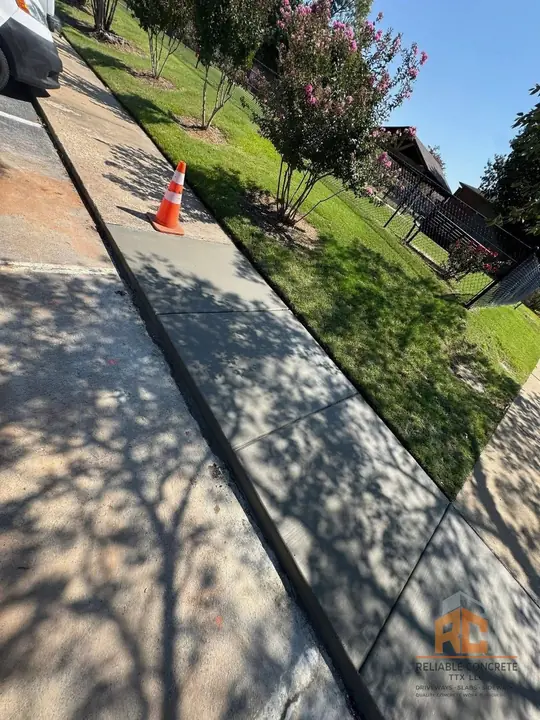
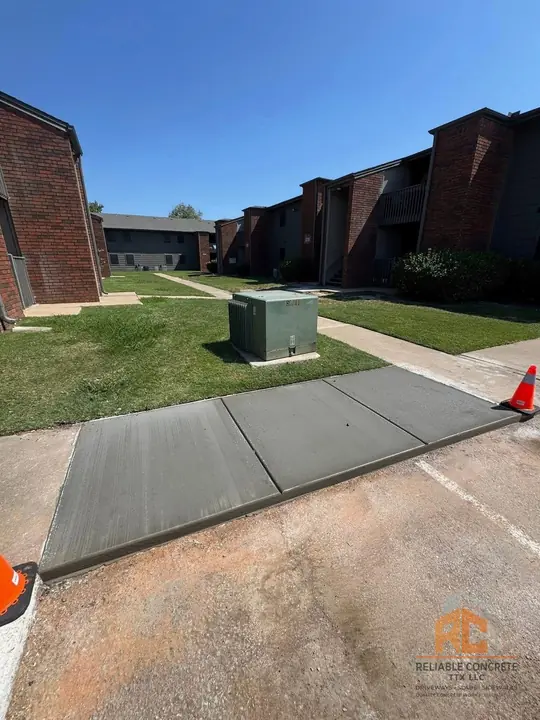
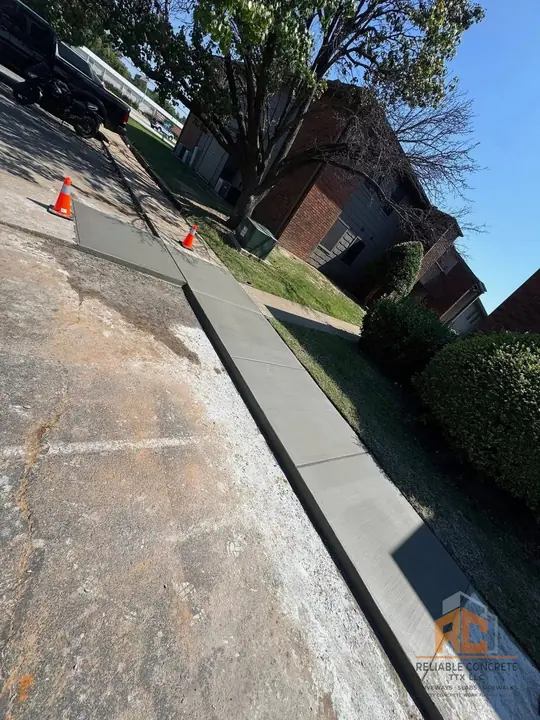
Questions we hear
Frequently asked
How wide should a front walk be?
Three feet works for a side path, but four to five feet feels more welcoming at the front door and lets two people walk side by side.
Who is responsible for the sidewalk in front of my house?
That depends on the city. In Tyler, check with the city before any work in the right-of-way.
Can you connect a new walk to my driveway?
Yes. We set an isolation joint where the two meet so each slab can move on its own without cracking the other.
Ready to talk about your concrete?
Let's get your project on solid ground.
Tell us what you need and we'll get back to you to talk it through and set up a time to look at the job.
Prefer to call?(903) 555-0100