
Concrete patios · Tyler, TX
Concrete patio installation in Tyler for back yards and porches
We install concrete patios in Tyler, TX, from new back patios and front porch slabs to stair landings and extensions that make an old patio bigger. Each one is sloped away from the house and reinforced for clay soil.

Signs it's time
Your backyard is not working for you
- There is nowhere flat to put a table, grill or chairs
- Your current patio is too small for how you actually use it
- Pavers have sunk, shifted or grown weeds between them
- A deck stair or back door lands on bare dirt or grass
A patio built for East Texas weather
The two things a patio has to get right are drainage and support. A patio should fall gently away from the foundation, usually around a quarter inch per foot, so rain from the roof runs into the yard and not against the house.
Support comes from the base. Clay under a patio swells after a wet week and shrinks in the summer, and a slab poured straight on that clay tends to crack or tilt. We grade, compact and add base where the soil calls for it, and set a rebar grid so the slab holds together if the ground moves.
Patio shapes, sizes and finishes
Most patios are 4 inches thick with a broom or smooth finish. Rounded corners, wraparounds and L-shapes are all just a matter of forming. If you want pattern or color, that is stamped concrete, which costs more but changes the look completely.
- Back patios off a kitchen or living room door
- Covered patio slabs under an existing or planned roof
- Landings at the foot of deck and porch stairs
- Extensions that widen an old patio with a clean joint between old and new
Thinking about a roof or pergola later?
Tell us before we pour. Posts for a pergola or patio cover carry real weight, and the slab may need thickened edges or separate footings where those posts land. It is far cheaper to plan for that now than to cut into a finished patio.
Cost and timing
Patio pricing comes down to size, access for the truck or a pump, how much grading the yard needs, and finish. Most patios pour in a single day. You can usually walk on it in a day or two and set furniture on it within a week.
Done to standard
How we do it to standard
-
Cracks go where we put them.
We lay out control joints by slab thickness and shape, and keep panels close to square.
Concrete shrinks as it cures and will crack somewhere. Joints decide where, so the crack lands in a straight line instead of across the middle of a panel.
Standard ACI 302.1R and the Portland Cement Association put joint spacing at about 24 to 36 times the slab thickness (8 to 12 feet for a 4-inch slab).
-
The seam between old and new stays level.
We drill and dowel new concrete into old where they must move together, or set an isolation joint where they must move apart.
An extension poured against old concrete with nothing between them cracks or steps at the seam within a season or two.
-
Built for the ground it actually sits on.
We treat East Texas clay as a design condition: base, steel, joints and drainage are sized for ground that swells wet and shrinks dry.
Expansive clay moves with the seasons. Concrete that ignores that movement cracks along lines nobody chose.
Standard Texas engineers measure clay movement as potential vertical rise (PVR), using the TxDOT Tex-124-E method.
-
One price, no pile left behind.
We include break-out and haul-off of old concrete in the quote.
Broken concrete is heavy and costs money to move. It belongs in the price, not as a surprise.
-
Each piece moves on its own.
We set isolation joint material where flatwork meets the house, columns, steps and existing slabs.
A slab locked to a foundation or a post cracks when either one moves.
-
Water stays on top of the slab.
We seal open joints and cracks with a flexible sealant on repair and sealing jobs.
Open joints let water under the slab, where it carries off base and swells the clay.
Step by step
How a patio job goes
-
Lay it out
Mark the size and shape, check slope and drainage.
-
Grade and base
Dig out, compact and add base where needed.
-
Forms and steel
Forms set to the slope, rebar grid on chairs.
-
Pour and finish
Placed, finished, joints cut and cured.
Know the words
Terms you'll hear
- Expansive clay
- Clay that swells when wet and shrinks when it dries. It is the main reason East Texas concrete cracks, heaves and settles.
- Isolation joint
- A full-depth joint that separates a slab from a structure or another slab. It stops movement in one piece from cracking the other.
- Dowel bars
- Short steel bars drilled and epoxied into an existing slab to tie new concrete to it. They keep new and old concrete level with each other at the seam.
- Sloped lot
- A yard with enough fall to need steps, walls or cut-and-fill. Grade changes are where walls, steps and drainage all meet.
- Settlement cracks
- Cracks where one side has dropped below the other. They mean the ground moved. Patching the crack alone does not fix it.
- Sunken slab
- A slab that dropped as the ground below washed out or compressed. Often liftable if it is still in one piece.
From our recent work
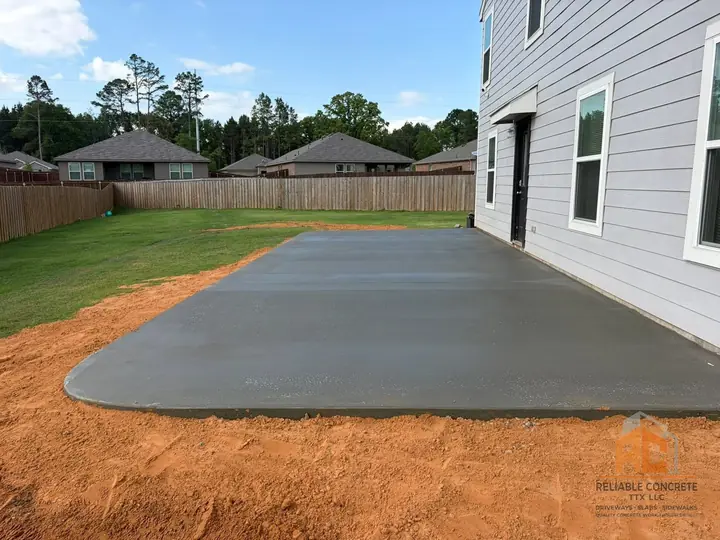
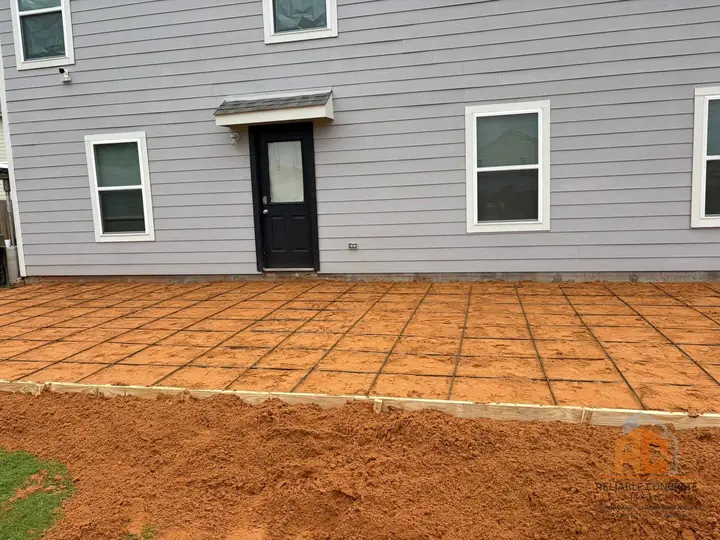
More photos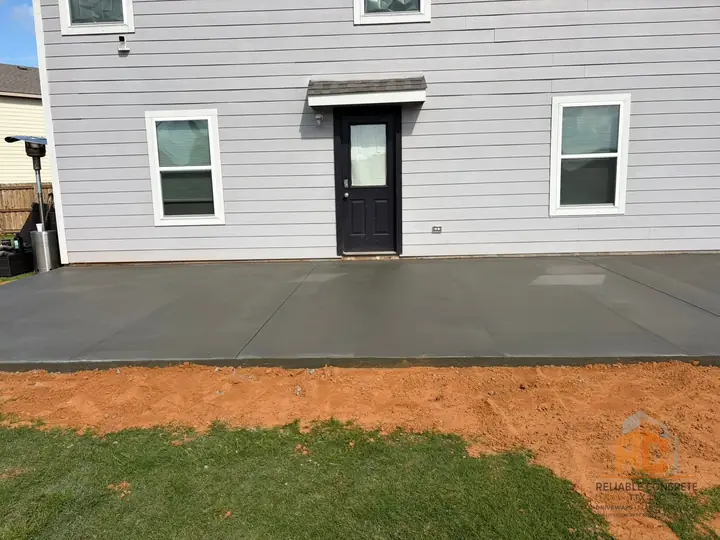
Questions we hear
Frequently asked
Is concrete better than pavers for a patio?
Concrete is one continuous slab, so there are no joints to sink or grow weeds. Pavers are easier to patch. In clay soil, a reinforced slab tends to stay flatter longer.
Can you add on to my existing patio?
Yes, if the old slab is sound. We tie the new section in with an isolation joint or dowels so the seam stays tidy. If the old patio is broken, replacing it may make more sense.
Should I seal my new patio?
A sealer helps against water, stains and the sun. It goes on after the concrete cures. About concrete sealing.
Will new concrete match my old concrete?
New concrete is lighter at first and never matches exactly. It evens out with age.
Ready to talk about your concrete?
Let's get your project on solid ground.
Tell us what you need and we'll get back to you to talk it through and set up a time to look at the job.
Prefer to call?(903) 555-0100